
Permanent School Fund
Constitutional Amendment Would Increase Funding For Schools
Passage of the Amendment Would Increase Distributions From the Permanent School Fund.
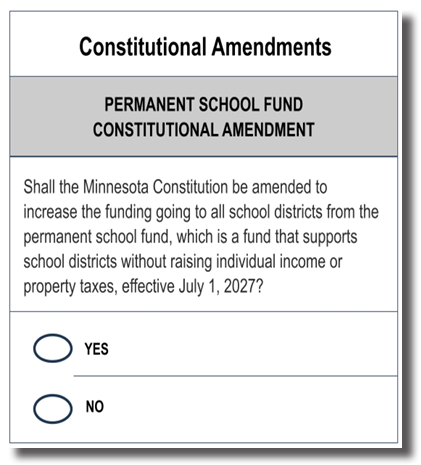
The Minnesota Legislature approved bipartisan legislation in the 2026 legislative session placing a question on the ballot in November to amend the State Constitution. The proposed amendment would modernize the distribution formula from the Permanent School Fund (PSF) increasing the funding schools receive.
In 1785, Congress created a system for organizing the westward expansion. The land was divided into townships, and each township was split into 36 sections. To help support public education, Congress set aside one section in every township, with the land or its proceeds dedicated to funding local public schools. Minnesota’s Department of Natural Resources manages about 2.5 million acres of school trust land, with proceeds from land management activities such as timber sales, mining, and land leases added to the fund. Revenues are invested by the State Board of Investment, and the MN Department of Education annually distributes a portion to every public school district.
Minnesota’s Constitution currently limits distributions to the net interest and dividends earned on the Fund. If voters approve the Constitutional amendment this November, the distributions could include capital gains from asset appreciation and the state would adopt a 4.5 percent distribution rate, calculated using a three-year rolling average of the Fund’s value. In recent years, distributions have averaged only 2.5% of the fund’s value.
The proposed amendment would modernize the distribution formula from the PSF and modestly increase the funding schools receive from the fund. For example, had the proposed formula been in effect for FY25, schools would have received approximately $33 more per student than under the current distribution method. School districts will continue to rely on voter approved referendums to ensure their students have the resources and opportunities they need to be successful.
Passage of this amendment will provide a funding increase without increasing taxes and without using revenue from the state general fund.
For the amendment to be approved, the question must receive a majority of all votes cast in the election. If a voter does not vote on the question, it has the effect of being a “no” vote.