School Board election - 3 positions open

School Board Candidate Filing Now Open!
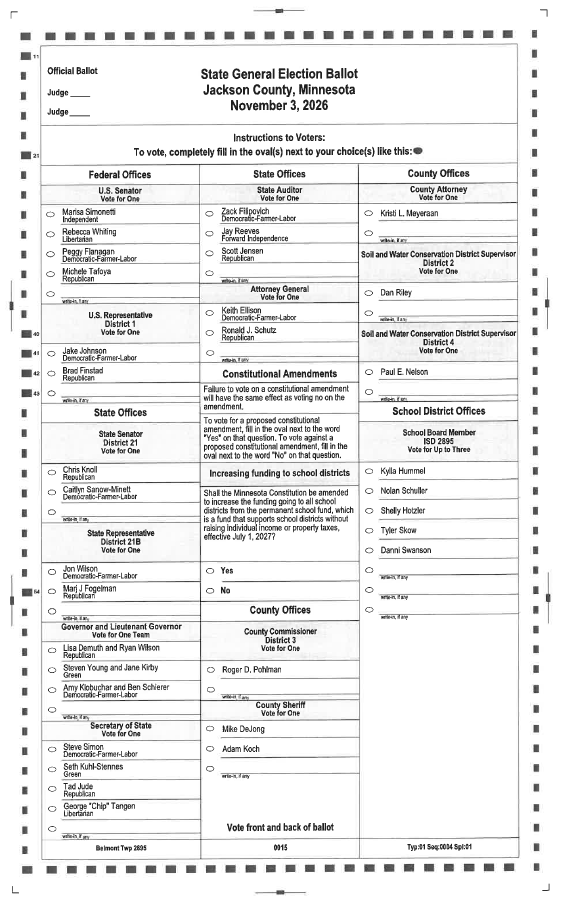
Jackson County Central Schools will have three School Board seats on the November 2026 ballot. The candidate filing period is July 14–28, 2026.
To file for candidacy, applicants must submit a notarized Affidavit of Candidacy and a $2 filing fee. If needed, a Notary Public may be available at the JCC District Office. Please contact the District Office to confirm availability.
To be a school board candidate you must be at least 21 years of age when the term begins, be an eligible voter, and reside in the district for at least 30 days before the election.
Affidavit of Candidacy forms are available at the JCC District Office, on the JCC website, or through the Minnesota Secretary of State's website.

Why the JCC Operating Referendum Matters

This November, residents of the Jackson County Central School District will once again have the opportunity to vote on an operating referendum. As we prepare for that important decision, we want to provide our community with clear information about the district's financial situation, the budget adjustments that have already been made, and why additional operating revenue remains an important need.

Significant Budget Adjustments Were Made Following Last Year's Referendum

After the operating referendum was not approved by voters last November, the district took immediate steps to reduce spending while continuing to provide a high-quality education for our students. During the spring, the School Board approved more than $550,000 in budget adjustments for the 2026-27 school year. These reductions were made only after careful review and thoughtful discussion, recognizing that every decision would have an impact on students, staff, and families.

The district's financial challenges continue to be driven by several factors, including declining enrollment, increasing health insurance costs, new state-paid medical leave requirements, declining compensatory and special education revenues, and additional state mandates that are not fully funded. Approximately 70 percent of a school district's budget is dedicated to employee salaries and benefits, making staffing reductions especially difficult but often necessary.

Expenditure Reductions

The approved budget adjustments affected many areas of district operations. Staffing changes included reductions in several elementary teaching positions, a high school social studies position, a portion of the high school choir program, physical education, middle school staffing, library paraprofessional support, and the school resource officer position. 

The district also reduced expenditures by:

  • Reducing classroom and departmental supply budgets.

  • Limiting administrator travel and overnight conferences.

  • Reducing extended contracts.

  • Scaling back selected technology and curriculum resources.

  • Making reductions in athletics and activities, including fewer assistant coaching positions, changes to transportation, and reductions in several extracurricular programs.

These were difficult decisions that were made only after careful consideration of the district's educational priorities.

Revenue Increases

In addition to reducing expenditures, the district also identified opportunities to increase local revenue in an effort to lessen the impact of budget reductions. These changes included:

  • Transportation fees for students living within state non-transportation limits.

  • Increases to certain high school class fees.

  • Modest increases in activity participation fees.

  • An increase in annual adult activity passes.

  • A seasonal fee for students utilizing the after-school activity bus.

While these changes helped offset a portion of the district's financial challenges, they generated only a small amount of additional revenue compared to the overall budget needs.

Why Another Referendum?

Even after implementing more than half a million dollars in budget adjustments, the district's long-term financial challenges remain. Last year's revised budget projected a deficit of approximately $706,000, and current projections continue to show enrollment declines over the coming years. At the same time, costs continue to rise while state funding has not kept pace with inflation or increasing educational mandates.  In June, the school board approved the preliminary budget for the 2026-27 school year that showed continued deficit spending of $418,000, even after the adjustments have been made.

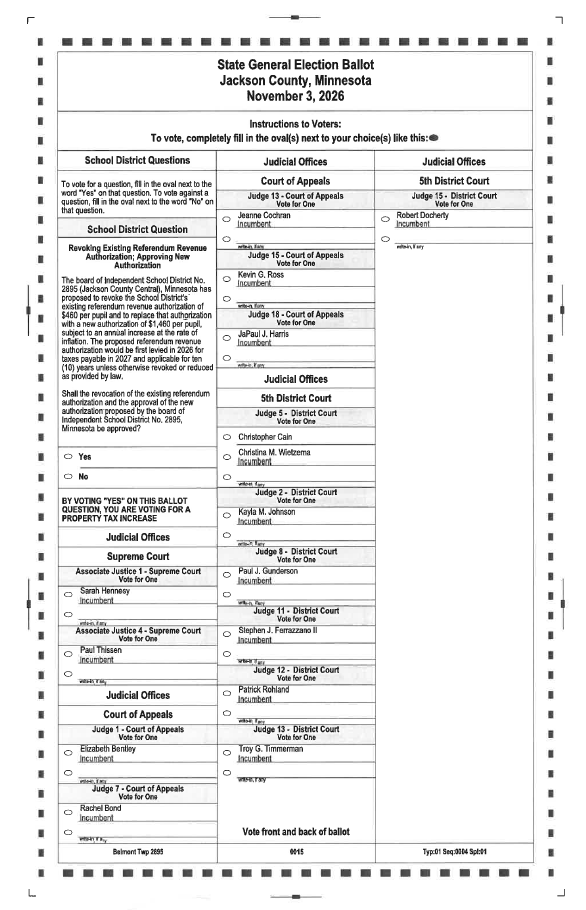
It is important to note that the current operating levy of $460 per student remains in place but is scheduled to expire during the 2027-28 school year. Last November's referendum would have replaced that levy with a new 10-year operating levy to provide more stable funding for the future. Because that question was not approved, the district continues to face significant financial challenges.

Staying Informed

The Jackson County Central School District is committed to providing factual, transparent information so community members can make an informed decision when they vote this November.

Throughout the coming months, the district will continue to share information about school finance, how public schools are funded, the district's current financial outlook, and what the proposed operating referendum would mean for students, staff, and taxpayers.

We encourage all residents to attend upcoming community information sessions, review the information available on the district website, and ask questions. Together, we can ensure every voter has the information needed to make an informed decision about the future of Jackson County Central Schools.





Understanding the Current Operating Levy

Jackson County Central currently receives an operating levy of $460 per student and that levy remains in place today (it was a 10-year levy).

  • Will expire during the 2027-28 school year.

  • Does not include annual inflationary increases.

Last year's referendum would have replaced the current levy with a new 10-year operating levy to provide more stable funding. Because that question was not approved, the district continues to face long-term financial challenges.


Why Operating Revenue Matters

Operating referendum dollars help support the everyday operation of our schools, including:

  • Classroom instruction

  • Student support services

  • Academic programs

  • Extracurricular opportunities

  • Safety and security

  • Transportation

  • Technology

  • Maintaining competitive educational opportunities for students

Stay Informed

Throughout the fall, the district will continue to provide information through:

  • Community information meetings

  • District website updates

  • Printed informational materials

  • Social media

  • Community presentations

We encourage all residents to attend an informational meeting, ask questions, and review the information available before the November 3 election.


Election Day

Tuesday, November 3, 2026

Key Communicators group

Thursday, August 6
6:15 p.m.
JCC High School Media Center

Understanding the 2026 Operating Referendum

On Tuesday, November 3, 2026, residents of the Jackson County Central School District will vote on an operating referendum. The district is committed to providing factual, transparent information so community members can make an informed decision.


Why is the District Asking Again?

Following the unsuccessful operating referendum last November, the School Board made more than $550,000 in budget reductions for the 2026-27 school year. Those reductions were made only after careful review and discussion, recognizing that every decision would affect students, staff, and families.

Even after those adjustments, the district continues to face ongoing financial challenges due to:

  • Declining student enrollment

  • Rising employee health insurance costs

  • New state-paid leave requirements

  • Declining compensatory and special education revenues

  • Additional state mandates that are not fully funded

  • State funding that has not kept pace with inflation

Approximately 70% of the district's budget is dedicated to employee salaries and benefits, making budget reductions especially challenging.


Budget Adjustments Already Made

Staffing Reductions

The district reduced staffing in several areas, including:

  • Elementary teaching positions

  • High School Social Studies

  • High School Choir

  • Physical Education

  • Middle School staffing

  • Library paraprofessional support

  • School Resource Officer (SRO)


Operational Reductions

The district also reduced spending by:

  • Lowering classroom and department supply budgets

  • Limiting administrator travel and conferences

  • Reducing extended contracts

  • Scaling back curriculum and technology purchases

  • Reducing athletic and activity expenditures

  • Decreasing assistant coaching positions

  • Adjusting transportation for activities

  • Reducing selected extracurricular programs

These decisions were difficult and were made to preserve as many educational opportunities as possible.

Revenue Increases

The district also increased local revenues by:

  • Transportation fees for students living within non-transportation limits

  • Increased certain high school class fees

  • Modest increases to activity participation fees

  • Increased adult activity passes

  • Seasonal fee for after-school activity bus riders

While helpful, these changes generated only a small amount of revenue compared to the district's overall financial needs.


Looking Ahead

Even after reducing expenditures and increasing revenues, the district continues to project budget deficits.

  • The previous revised budget projected a deficit of approximately $706,000.

  • The preliminary 2026-27 budget still projects approximately $418,000 in deficit spending after all budget adjustments were made.